
Most creators do not quit their job to start OnlyFans. They start next to it: evenings, weekends, a second income while the first one pays the rent. That makes one question more urgent than any growth tip: what happens if my employer finds out?
There is no single answer, because it depends on where you live, what you do and what you signed. But there is a clear way to think it through, and most of the work happens before your first post. This guide is for adults who already create or are considering it, and it matters even more if you are lesbian, bi, trans or queer and not out at work.
First, the honest part
If you have not started yet, read this before you decide.
- Published content is never fully under your control again. Fans can screenshot and record. Removal tools exist, but none of them reaches the whole internet.
- Privacy risk is real. Someone who connects your creator account to your legal name can share it with your workplace, your family or your landlord. For queer creators that can also mean being outed.
- Stigma is real and uneven. Some employers and some professions react far more harshly than others.
- Income is unpredictable. It can be very different from month to month, so do not plan your rent around it early on.
- It is taxable income in most countries, separate from your salary. OnlyFans says you are responsible for paying any tax you owe. Our tax basics guide explains the general picture.
None of this means you should not start. It means your day job deserves a plan.
How employers usually find out
The worry is often a background check. The real risk is people. A real example: in 2023 a high school teacher in St. Clair, Missouri, was placed on administrative leave after the district learned about her OnlyFans page. According to the superintendent, the district found it "through social media posts." She later resigned; the district said the resignation was voluntary.
Typical routes look like this:
- Someone recognises you. A colleague, a client or an acquaintance comes across your profile or a promo clip.
- Your promotion leads back to you. A social account that shares followers, photos or a username with your private profile.
- Your content gives you away. A tattoo, a room, a view from the window, a voice that people at work know.
- Someone tells. An ex, a jealous fan or a coworker passes it on.
You cannot rule all of this out. You can make each route much harder.
Which rules can apply to you
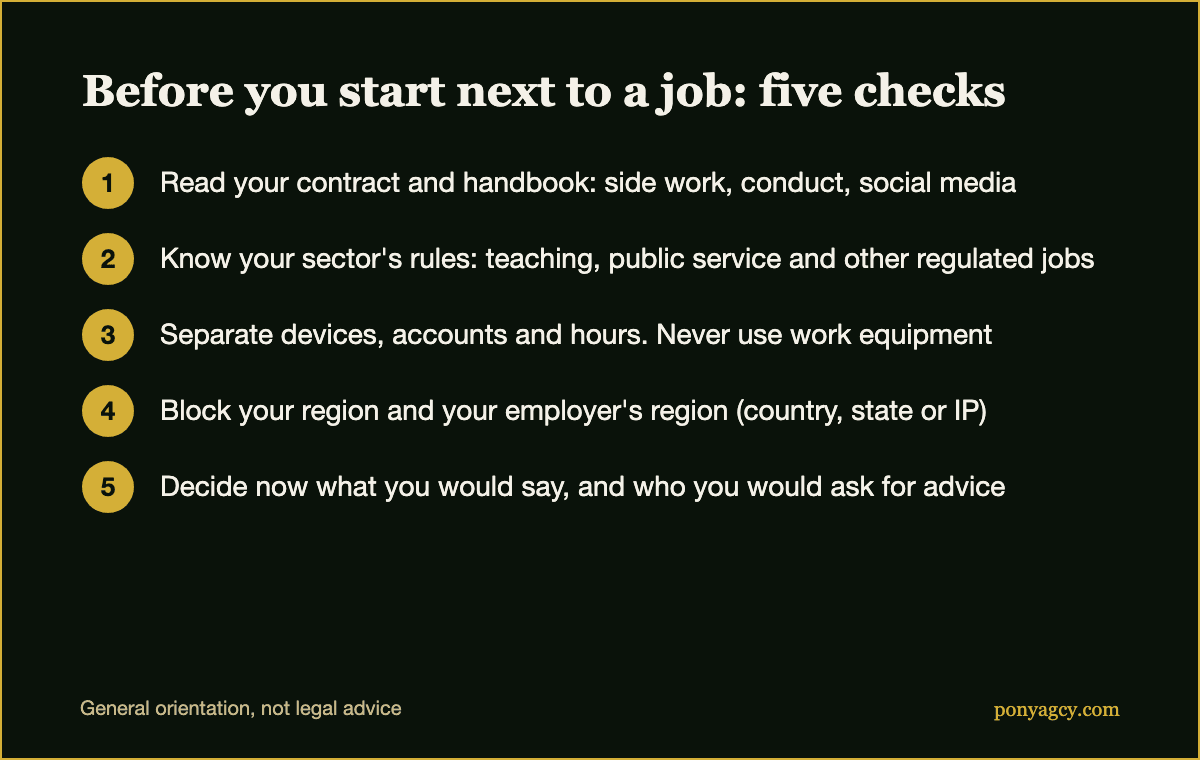
1. Your contract and handbook. Many employment contracts and staff handbooks have clauses on side jobs ("secondary employment" or "outside activities"), conflicts of interest, conduct and social media. Read them before you start. Some only ask you to tell the employer about any paid side work; some require permission.
2. Your country and state. The rules differ widely. Two examples from the US:
- Employment "at will" is the default standard in the US: either side can end the job at almost any time and for almost any reason, with exceptions that vary by state.
- A few states protect lawful off-duty activity, but with limits. Colorado treats firing someone for lawful activity off the employer's premises during non-working hours as an unfair employment practice, unless the restriction relates to a genuine occupational requirement, is reasonably related to that employee's responsibilities, or is needed to avoid a conflict of interest. New York protects "legal recreational activities" outside work hours, but defines them as leisure-time activities for which the employee receives no compensation. Paid creator work does not fit that wording.
3. Your sector. Some jobs carry conduct rules that reach into your private life:
- Teaching: In England, the Teachers' Standards say teachers uphold public trust in the profession and maintain high standards of ethics and behaviour "within and outside school."
- Public service: In Germany, federal civil servants need approval for almost any paid side activity, and approval must be refused if the activity could harm the reputation of the public administration (§ 99 Bundesbeamtengesetz). Civil servants of the federal states fall under their state's own law.
This is general orientation, not legal advice. If your job is in a regulated field, or you are unsure what your contract means, ask an employment lawyer, a union or a workers' advice service where you live before you start, not after something has happened.
Protect your main income: five steps
1. Keep everything separate. A stage name, a separate email and phone number, a separate bank login if you can. Never use a work laptop, work phone or work Wi-Fi for creator activity, and never create during working hours. Many employers can see what happens on their devices and networks, and a breach of IT policy is a much easier reason to act than anything you do at home.
2. Block where your work is. OnlyFans lets you hide your profile from certain IP addresses, countries, or individual states and provinces in the US, Australia and Canada. You find this in the "Safety" section of the "Privacy and safety" settings. Block your own region and the region where your employer is based. It is not a guarantee, because people travel and use VPNs, but it removes the most likely viewers.
3. Keep your face and features out, if you need to. Many creators work without showing their face. Cover or crop tattoos, birthmarks and jewellery you wear at work, and check every background. Our guide to OnlyFans without showing your face goes through this in detail.
4. Do not share personal details with fans. OnlyFans itself asks creators not to share their full name, address or personal contact information. That includes your job, your company and your city.
5. Promote with a separate identity. Social accounts for your creator work should have no overlap with your private ones: no shared followers, photos, usernames or phone number for account recovery.
Decide now what you would do if it comes out
Thinking this through when you are calm is far easier than in a meeting with HR.
- Do not answer on the spot. You can ask for the concern in writing and for time to respond.
- Know your contract. Did you have to report side work? If yes, it may be safer to deal with that first, on your terms.
- Get advice early. A union, an employment lawyer or a workers' advice service can tell you what applies to you.
- Keep your evidence. If a colleague found your content and spread it at work, keep screenshots. Sharing someone's intimate images without consent can be a matter for the platform and, depending on where you live, the police.
- Have a fallback. Know roughly how long you could cover your costs if the main income stopped.
Where Pony fits
Pony Agency manages OnlyFans, Fansly and MYM for adult creators, with a personal manager, fan messaging, content and pricing strategy, posting-time analysis, promotion and privacy support including DMCA takedowns. For creators with a day job, that means the time-consuming parts are handled, and your privacy settings, including geo-blocking, are part of the setup from the start.
For full management, the split is 60% to Pony Agency and 40% to the creator, calculated on net revenue after platform fees and any chargebacks or reversals. The agreement is non-exclusive and either side can end it with 30 days' notice. Your content stays yours, and accounts you already have stay yours.
If you want to build a creator business next to your job without risking it, apply for a fit review. An application starts a conversation, and you decide whether it goes further.
Sources
Accessed 2026-10-14.
- OnlyFans Help: Can I hide my profile?
- OnlyFans Help: Can I share personal information with Fans?
- OnlyFans Help: Do I have to pay tax on any earnings from OnlyFans?
- KY3: High school teacher suspended for her OnlyFans page has resigned, superintendent says (11 October 2023)
- Cornell Law School, Legal Information Institute: Employment-at-will doctrine
- Colorado Revised Statutes § 24-34-402.5
- New York Labor Law § 201-D
- Department for Education: Teachers' Standards
- § 99 Bundesbeamtengesetz (BBG)
Cover photo: Luca Bravo, via Wikimedia Commons, CC0 (public domain). Cropped to 16:9. Checklist graphic: Pony Agency.