
Sooner or later, almost every creator asks the same question: do I tell the people close to me? Your partner, your parents, your siblings, your best friend. Some people around you may already be wondering where the extra income comes from or why your phone is always face down.
If you are lesbian, bi, trans or queer, this can feel like a second coming out. Maybe you went through the first one and know what it cost. Maybe you have not had the first one yet, and now there are two things you are holding back. This guide is for adults who already create or are considering it. It will not tell you what to do. It helps you decide on purpose instead of by accident.
First, the honest part
If you have not started yet, these points belong in the decision, both about OnlyFans and about who you tell.
- Published content is never fully under your control again. Fans can screenshot and record. Removal tools exist, but none of them reaches the whole internet. That also means someone close to you could find it one day, whether you told them or not.
- Privacy risk is real. Someone who connects your creator account to your legal name can share it with your family, your workplace or your landlord. For queer creators, that can also mean being outed.
- Stigma is real. Some people react with worry, some with anger, some with silence. You cannot control which one you get.
- Income is unpredictable. It can change a lot from month to month, so do not promise anyone, including yourself, a fixed amount.
- It is taxable income in most countries. OnlyFans says creators are responsible for paying any tax they owe. Our tax basics guide explains the general picture.
None of this means you should not start. It means telling people is a decision that deserves the same care as the account itself.
You do not owe everyone the same answer
There are three legitimate choices, and you can make a different one for each person:
- Tell them everything: what you do, on which platform, and roughly what it involves.
- Tell them part of it: for example, "I do online creator work for adults" without the platform, the stage name or any details.
- Do not tell them: at least not now.
Research on in-person sex work shows how common this mix is. A Canadian study of 218 sex workers (Jansson et al., The Journal of Sex Research, 2022) found that most of those who had been in a relationship, 151 of 183, had told at least one partner. For most of them, that disclosure had at least one negative consequence. A smaller group described acceptance, support and understanding. A minority kept their work secret from at least one partner or shared only limited information, which shielded them from stigma but left them with what the authors call "a burden of secrecy." Some avoided the dilemma by forming relationships with people who already knew what they did.
That study is about in-person sex work in Canada, not OnlyFans, so do not read it as a forecast. What it shows is simple: there is no answer that is free of cost. Secrecy has a price, and so does telling.
Four questions before you tell anyone
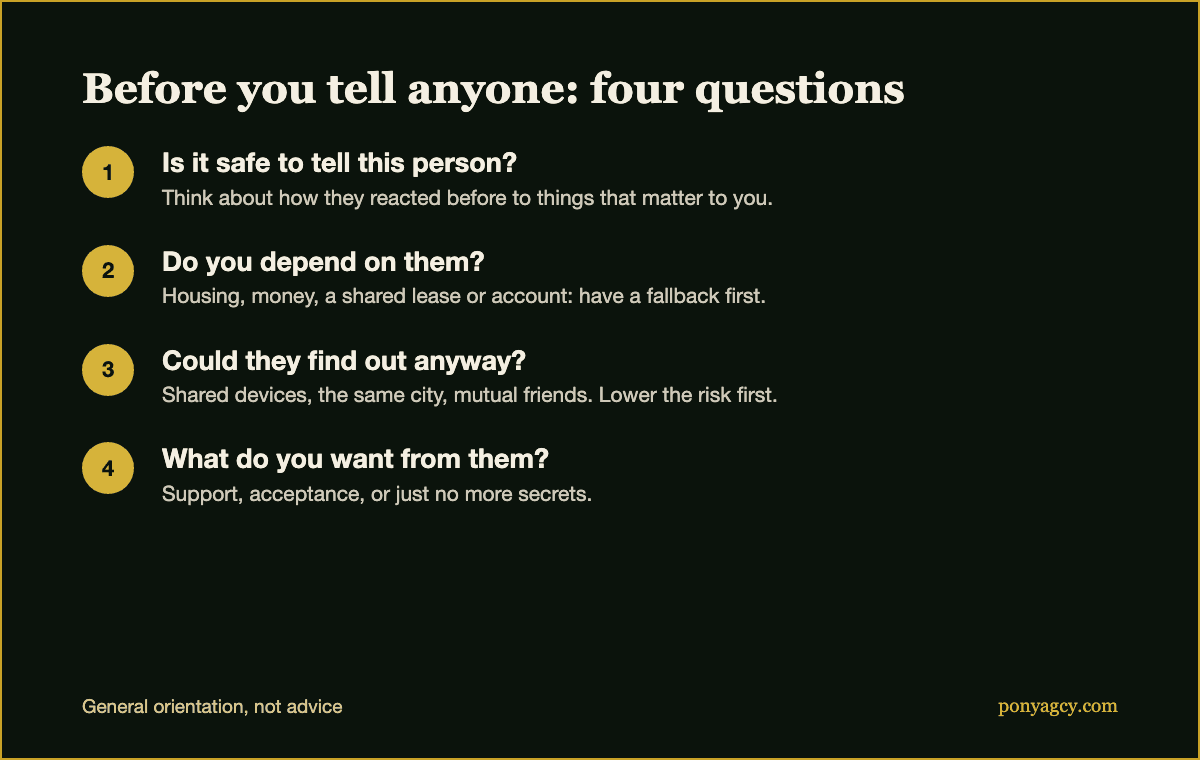
1. Is it safe to tell this person? Think about how they have reacted to things that matter to you before, including your sexuality or gender identity if they know. If you expect threats, violence or being thrown out, safety comes first, and the answer for now may be no.
2. Do you depend on them? If you live with your parents, rely on them for money, or share a lease or bank account with a partner, their reaction can affect your housing and your finances. In that case, make sure you have a fallback before the conversation, not after.
3. Could they find out anyway? A shared laptop, a shared streaming or cloud account, the same city, mutual friends who follow your promotion accounts. If the risk of someone finding out is high, telling them yourself is often better than having them stumble on it. You can also lower the risk first: OnlyFans lets you hide your profile from certain countries and, in the US, Australia and Canada, from individual states and provinces. That setting is in the "Safety" section of "Privacy and safety."
4. What do you want from them? Support? Acceptance? Just no more lies? Practical help, such as childcare while you film? If you know what you are asking for, the conversation has a direction.
Your partner: a different conversation
A partner is usually affected more directly than a parent: by your time, your boundaries, your privacy and sometimes your shared money. That is why many creators decide to tell a partner, even if they keep it from family.
Before you talk, decide what is not up for negotiation:
- Your account stays yours. Your login, your password and your fan conversations are not shared.
- Your money stays under your control. Earnings go to an account in your name.
- Your boundaries are yours. What you create and what you do not create is your decision. You can talk about it, but a partner does not get a veto over your body.
Then talk about what you can agree on together: which content stays private between you, how you handle being recognised in public, and what happens to your shared plans if the income changes.
If you create as a couple, the questions are different again. Our guide for queer couples on OnlyFans goes through verification, money and what happens if you split.
How to have the conversation
- Choose the moment. In person, privately, with time afterwards. Not at a family celebration, not during an argument, not by text if you can avoid it.
- Say the main thing early. Long introductions make people imagine something worse.
- Lead with your reasons. Why you do it, and how you protect yourself: stage name, separate accounts, geo-blocking. Worried people often calm down once they hear you have a plan.
- Say what you are not sharing. "I am not going to show you the account, and I am not going to discuss my income." A clear boundary at the start saves you arguments later.
- Give them time. The first reaction is rarely the last one. Offer to talk again in a few days.
- Do not let them decide for you. You are telling them, not asking for permission.
If you have not come out yet, you do not have to have both conversations at once. You can choose the order, or keep one of them for later.
When the reaction turns into control
Disappointment, worry and even anger can be part of a hard conversation. Threats are something else.
Galop, a UK charity for LGBT+ people affected by abuse, lists warning signs from a partner or family member, including threatening to "out" your orientation or gender identity, controlling you financially, and using your gender or orientation as a basis for threats. The US National Domestic Violence Hotline describes financial abuse as a partner controlling your money or your ability to provide for yourself, for example by taking the money you earn and deciding where it goes.
If someone threatens to send your content or your identity to your employer or family, or demands your passwords or your earnings:
- Keep evidence. Screenshots of messages, with date and time.
- Secure your accounts. Change passwords, turn on two-step verification, sign out of shared devices.
- Get support. In the UK, Galop runs the National Helpline for LGBT+ Victims and Survivors of Abuse and Violence (0800 999 5428). In the US, the National Domestic Violence Hotline is on 1-800-799-7233, or text START to 88788. Elsewhere, look for a local domestic abuse or LGBT+ support service.
Sharing someone's intimate images without consent can, depending on where you live, be a matter for the platform and the police. Our guide on what to do if your content is leaked covers the next steps.
If someone finds out before you tell them
It happens. If a family member or partner confronts you:
- Stay calm and do not deny reflexively. A denial that falls apart later costs more trust than the truth.
- Ask for time. "Yes, it is true. I want to talk about it properly. Can we do it tomorrow?" is a complete answer.
- Find out how they learned about it. If your account or your promotion led them to you, other people can follow the same path. Close that gap first.
Where Pony fits
Pony Agency manages OnlyFans, Fansly and MYM for adult creators, with a personal manager, fan messaging, content and pricing strategy, posting-time analysis, promotion and privacy support including DMCA takedowns. Separate identities, geo-blocking and a stage name that does not lead back to you are part of the setup from the start. That way you decide who learns about your work, and when.
For full management, the split is 60% to Pony Agency and 40% to the creator, calculated on net revenue after platform fees and any chargebacks or reversals. The agreement is non-exclusive and either side can end it with 30 days' notice. Your content stays yours, and accounts you already have stay yours.
If you want to build a creator business with a privacy setup you can stand behind, apply for a fit review. An application starts a conversation, and you decide whether it goes further.
Sources
Accessed 2026-10-17.
- Jansson, M., Smith, M., Benoit, C., Magnuson, D., & Healey, P. (2022). Challenges and Benefits of Disclosure of Sex Work to Intimate Partners. The Journal of Sex Research
- Galop: Domestic abuse
- Galop: National Helpline for LGBT+ Victims and Survivors of Abuse and Violence
- National Domestic Violence Hotline: What is financial abuse?
- OnlyFans Help: Can I hide my profile?
- OnlyFans Help: Do I have to pay tax on any earnings from OnlyFans?
Cover photo: Joshua Ness, via Wikimedia Commons, CC0 (public domain). Cropped to 16:9. Question graphic: Pony Agency.