You sold a custom video, the fan said thank you, and the money showed up in your statement. Then, a few weeks later, your balance is lower than it should be. The fan went to their bank and disputed the payment. That is a chargeback, and on OnlyFans it comes out of your earnings.
Chargebacks are one of the least talked-about money problems for creators. This guide explains what OnlyFans' own terms say, why fans dispute payments, and what you can actually do about it. It is for adults who already create and for anyone thinking about starting.
First, the honest part
If you are still deciding whether to start, chargebacks are one more reason to keep your expectations realistic.
- Income is unpredictable. It changes from month to month, and money that appears in your statement is not always money you can keep.
- Published content is never fully under your control again. Someone who charged back a payment may still have saved what they bought.
- Privacy and stigma are real risks. Someone who connects your account to your legal name can expose you. For queer creators that can also mean being outed.
- It is taxable income in most countries. Our tax basics guide explains the general picture.
None of this means you should not start. It means you should plan your money with these risks in mind.
What a chargeback is
A chargeback starts when a cardholder asks their card issuer, usually their bank, to reverse a payment instead of asking the seller for a refund. The bank then investigates and can take the money back.
Fans on OnlyFans do not pay you directly. According to OnlyFans' Terms of Use, all fan payments are received and processed by a third-party payment provider approved by OnlyFans. So the dispute runs between the fan's bank and the platform's payment side. You are usually not part of that conversation, but you carry the cost.
Chargebacks can arrive long after the sale. In the US, for example, the Consumer Financial Protection Bureau explains that to protect their rights, a cardholder must send a written billing error notice within 60 days after the charge appeared on their statement. Card networks have their own rules and time limits on top of that. In practice, a sale can be disputed weeks after you were paid for it.
What OnlyFans' terms say
Three passages matter for creators.
1. The deduction. OnlyFans' Terms of Use say: "If a Fan successfully seeks a refund or chargeback from their credit card provider of a Fan Payment, we may deduct an amount equal to the Creator Earnings portion of the refunded or chargedback amount."
In plain words: the platform keeps its 20% fee on each fan payment, which the same terms state, and the part that went to you can be taken back from you.
2. What fans agree to. The same terms say fans agree not to make "unjustified chargeback requests" for any creator interaction or tip, and that if OnlyFans determines a refund or chargeback request was made in bad faith, it "may suspend or delete" the fan's account. The separate Contract between Fan and Creator adds that the fan agrees "not to initiate a chargeback unless the Fan disputes the Creator Interaction in good faith."
3. What you agree to. The Contract between Fan and Creator also says the creator agrees to provide paid content once the fan has paid. Delivering what you sold, as you described it, is your side of the deal, and it is your best protection.
This is general orientation based on the terms as published at the time of writing (last updated August 2024 according to OnlyFans). Read the current version yourself. It is not legal advice.
Why fans charge back
Visa describes "friendly fraud", also called first-party misuse, as a cardholder disputing a legitimate transaction that they or someone in their household made. Visa lists typical forms, and several of them fit creator platforms well:
- Household misuse: someone else in the household used a saved card, and the cardholder disputes the charge.
- Descriptor confusion: the cardholder does not recognise the merchant name on their statement.
- "Free goods" attempts: disputing a valid purchase to keep what was bought without paying.
Other causes are not about bad faith at all: a stolen card used on the platform, or a fan who feels the content was not what was promised. You cannot prevent the first. You can do a lot about the second.
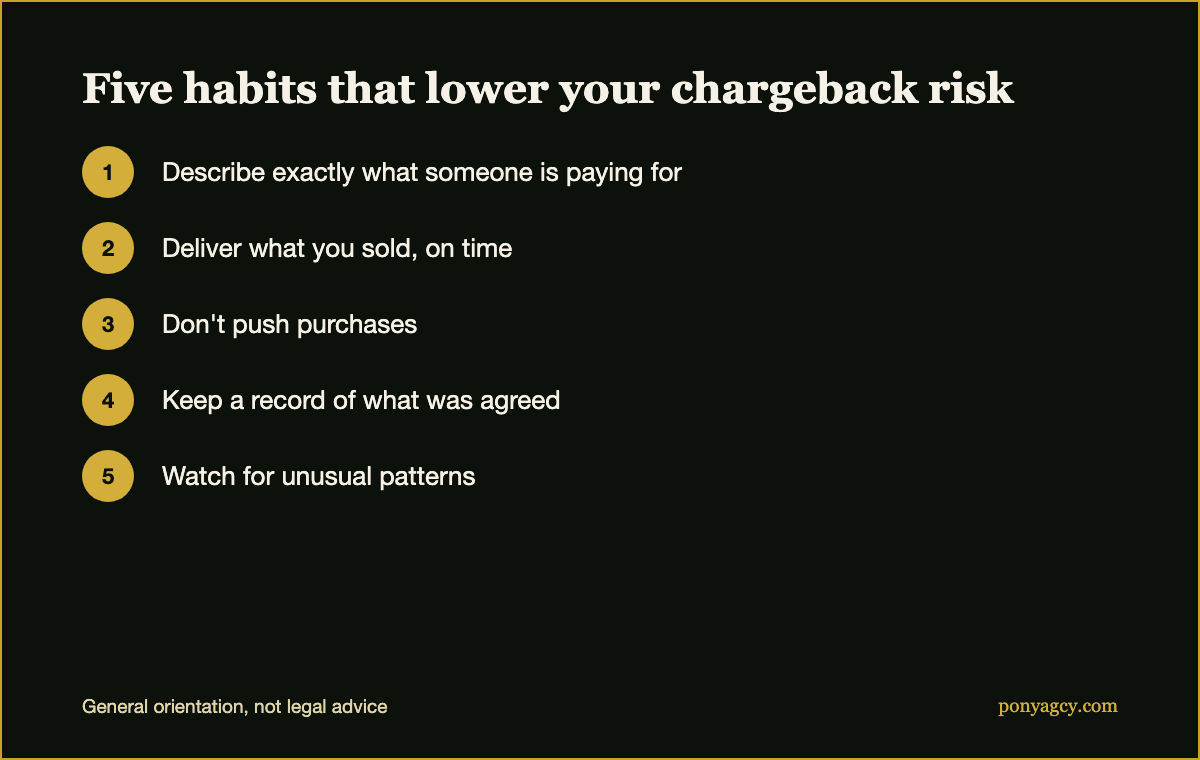
Before the sale: five habits that lower the risk
1. Describe exactly what someone is paying for. For pay-per-view messages and customs, say clearly what the content is, how long it is and what it does not include. A fan who gets exactly what was described has little ground for a good-faith dispute.
2. Deliver what you sold, on time. Customs that arrive late or not at all are a classic reason for a dispute. Agree on a delivery time and keep it, or tell the fan early if something changes.
3. Do not push purchases. Pressure, countdowns and messages that rush someone into a big purchase lead to regret, and regret leads to disputes. A calm, honest sales style is safer for your income and fairer to your fans.
4. Keep a record. Save what was agreed for customs and larger purchases, with date and time: the request, your description, the price and the delivery. You may never need it. If OnlyFans support asks, you have it.
5. Watch for unusual patterns. A brand-new fan who spends a lot very quickly, asks you to deliver outside the platform or changes their story is worth slowing down for. Never move a payment or a delivery off the platform: outside it, the platform's terms do not cover the deal, and you lose the record of it.
After a chargeback: what to do
- Check your statements. Look at which payment was reversed and how much was deducted.
- Contact OnlyFans support if you think the deduction is wrong, and have your records ready. OnlyFans also publishes a Complaints Policy, which its terms name as the route for disputing certain decisions about creator earnings.
- Do not confront or threaten the fan. It will not get your money back and can create new problems. If a fan is abusive, our guide on how to block and report abusive fans explains the tools.
- Learn from it. Was the description unclear? Was the delivery late? Was there pressure? Change the habit, not just the price.
Plan your money for it
The simplest protection is in your own budget. Treat recent earnings as not quite final yet, especially from a large single purchase, and keep a buffer before you count on the money for rent or bills. If you are thinking about leaving a job, our guide on going full-time without the risk explains how to build that buffer.
Where Pony fits
Pony Agency manages OnlyFans, Fansly and MYM for adult creators, with a personal manager, fan messaging, content and pricing strategy, posting-time analysis, promotion and privacy support including DMCA takedowns. Clear offers, honest messaging without pressure and reliable delivery are part of how we work with fans, because that is what keeps a relationship, and the money, stable.
For full management, the split is 60% to Pony Agency and 40% to the creator, calculated on net revenue after platform fees and any chargebacks or reversals. Money that a fan charges back is not part of the revenue we share. The agreement is non-exclusive and either side can end it with 30 days' notice. Your content stays yours, and accounts you already have stay yours.
If you want your creator business run with that kind of care, apply for a fit review. An application starts a conversation, and you decide whether it goes further.
Sources
Accessed 2026-10-21.
- OnlyFans: Terms of Use (last updated August 2024)
- OnlyFans: Contract between Fan and Creator (last updated August 2024)
- Consumer Financial Protection Bureau: How do I dispute a charge on my credit card bill?
- Visa: Friendly fraud
Cover photo: Mañico, via Wikimedia Commons, CC0 (public domain). Cropped to 16:9. Checklist graphic: Pony Agency.